
This post contains mild spoilers, but nothing that cannot be glossed from a blurb or short synopsis.
I love her. I am her cat.
Daru in “She and Her Cat: Everything Flows”, episode 1
She and Her Cat is a story that has been told by Makoto Shinkai three times – first as a short film, then as a novel, and finally as an anime series. This post compares and contrasts them and argues why the third iteration – the anime series – is the most perfect version of the story.
The different iterations of She and Her Cat



If you think you may have heard the title She and Her Cat before, that’s because you probably have! The first iteration was a 1999 five-minute short created and directed by Makoto Shinkai. The film is told from the perspective of Chobi, a cat enamoured with his owner, as he witnesses her move through a difficult period in her life. Chobi doesn’t understand the cause of her depression, but he waits at home each day, eager to comfort her.
The next iteration of She and Her Cat came in 2013 with a novel of the same name, by Makoto Shinkai and Naruki Nagakawa (note: it was not translated into English until 2022). This is arguably the most famous version of the story, having been a bestseller in Japan. The novel expands the world and themes of the short film, introducing more characters and settings. Some chapters are told from the perspective of Chobi (the original cat from the short film). Others are told from other cats’ perspectives as well as the perspectives of their owners. A key difference that sets this work apart is that the cats understand human speech in this version.
Finally, we arrive at She and Her Cat: Everything Flows – the 2016 4-episode long anime. This iteration actually centres on two new characters – cat, Daru, and owner, Miyu – however it relies on the same themes of loneliness and communication as the two previous versions, and follows much of the same narrative.
Everything Flows – the perfect in between
Each version of She and Her Cat is told by narrators who are a little dreamy; this seems to make sense as it’s such a contemplative, slow story, especially when one of those narrators is a cat who has little to do other than gaze out of the window and ponder his and his owner’s lives. With themes of grief, loneliness, defeat and new beginnings, Everything Flows is an impressively heartfelt story, able to move the audience to tears in spite of its short run-time.
Faraway things look small and hazy, and nearby things appear clearly. Memories are the same.
Daru in “She and Her Cat: Everything Flows”, episode 3
As mentioned in the Different iterations section, this version of the story follows a different cat and owner, Daru and Miyu, though their situation is very similar to that of Chobi and Kanojo (who feature in the short film and novel): a cat lives alone with his owner, who is going through a difficult situation.

Everything Flows, whilst focusing on different characters, is a return to the short film, due to the creators’ decision to only focus on a handful of characters and the crux of the story. This decision to compact it down to its most essential elements, for me, allowed the meaning of the original short film to be felt much more strongly than the book or the original short managed. Whilst the short film is too short to develop strong attachments to the characters, the novel I think focuses on too many characters. Everything Flows, on the other hand, feels perfectly balanced. The narrative focuses mainly on the young man (she) and her cat. Episodes are 7 minutes long and there are only four of them – and yet it manages to develop as much intrigue as a full feature film. With wonderfully measured timing that allows you to soak up the emotions in each scene, these are contemplative, slow-moving episodes that stay with you long after the run-time is over. When Miyu leaves for work, we see Daru wait for her throughout the day, and we feel how long he is alone for.
Part of what never really worked for me in the short film or in the novel is the fact that the cat’s admiration for his owner blurs the line between platonic, familial and romantic love, which never really worked for me. Everything Flows keeps something of this notion, but it is clear that the love Daru feels for Miyu is much more familial than anything else – something which feels much more charming to me.
I am also glad that the anime saw the return of the cat not understanding human speech. It was an element of the novel that I did not really enjoy as to me it seemed unnecessary to the plot and like it got in the way of a lot of intrigue. I find the lack of understanding much more compelling. It also makes Daru’s experience of witnessing his owner upset all the more harrowing – he has no idea why she is sad, if it is a period that is likely to last long, or what kind of comfort she needs – all details that could have been gleamed if he could understand the conversations she has over the phone. Keeping him in the dark makes his experience more lonely, and his struggle to reach her all the more emotional, making the audience even more eager for Daru to succeed in reaching her.
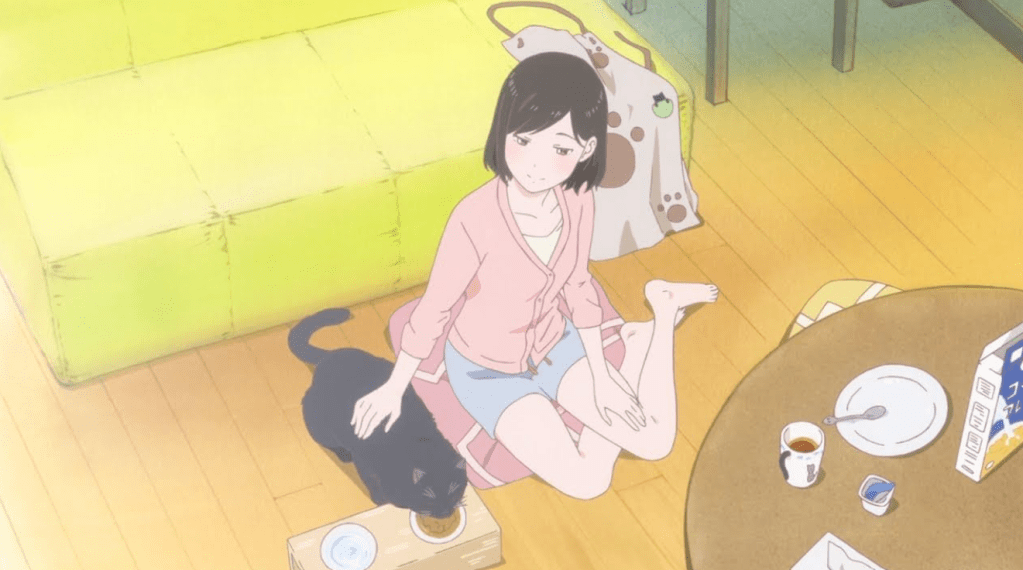
This absence of speech, I believe, manages to get to the heart of what Makoto Shinkai’s idea is really all about: a pure love that crosses the boundaries of language. In a world that feels ever more divided, I think stories like this are crucial.
Praise must also be given to Liden Films, the animation studio behind Everything Flows. They are the same studio that brought us Tokyo Revengers, Insomniacs After School and, most recently, the upcoming 2023 Rurouni Kenshin adaptation. The style used for Everything Flows is charming and very reminiscent of recent slice of life anime art styles, and the soft linework matches the slow pace. A very soft palate has been used too, which adds to its dream-like quality. There is an intimate quality to its storytelling too – with scenes often taking place in bedrooms, bathrooms, or with the characters gazing out of windows. It’s a style that worked perfectly in conjunction with the tone.
All of these elements made for a moving story that for me was impossible to watch without a tissue in hand. I found myself attached to the characters and story very quickly, and I will be thinking fondly of Daru and Miyu for weeks to come. The story is also circular, so I encourage viewers to go back to the first scene, left purposefully vague, to appreciate a fuller understanding.
Conclusion
As someone who grew up with cats myself, you can tell just how much feeling and admiration for our four-legged friends went into each of these works. Everyone will have a different favourite because there is something magical to be gained from each of these works. For me, Everything Flows is the most touching version of the story, able to communicate the themes in the most heartfelt way – it is a real creative achievement.
If you have watched or read any version of She and Her Cat, I’d love to know your thoughts!
Image sources
Featured image of Daru
Poster for the 1999 original short film
The English language edition of the novel
Poster for the 2016 anime
Stills from the 2016 anime
 izzy-lamb.com